skip to main |
skip to sidebar
 Just heard that one of my readers is concerned that I have not written in my blog for so long. It feels good to know I have an audience (of one at least!) on the other side of the Atlantic, who is interested enough in my blog to notice and care. Even with the slow increase on the hit counter, it is hard to believe that one is being read, and I would love to have more comments, even if they are critical. I enjoy being unexpected and provocative, but perhaps I am deluding myself in thinking that what I write is anything out of the ordinary these days. I am fairly sure that I do not conform wholly to the general stereotype of an old woman, but there must be many other atypical old crones out there, and I would love to read their blogs too.Anyway, I am sorry not to be more regular with my entries. And I realise that with the title "Not dead yet!" I have created a heightened expectation of termination!! I even discussed with a good mate - only half playfully - the possibility of writing my own obit now, and lodging it with him, so that he could post it for me when I do eventually go. Perhaps I should address myself to that more seriously. After all, people leave final video messages for their heirs, don't they?Two reasons for my recent silence: firstly, I am still much occupied and preoccupied with the health and wellbeing of my good old friend Michael, about whom I posted in my February blog about Growing Old: this leaves me tired and depressed, and feeling far from creative. And secondly: I use my blog to express the unfulfilled writer in me, mostly drafting my blogs in Word first and editing them carefully. The sort of off-the-cuff diary entry which I am writing now does not come so naturally. But thanks for noticing and caring.
How, you may be asking yourself, would anyone dream up a title like that? Well - that is exactly what I did, I dreamed it. I don't remember anything else about the dream except that I had had people staying in my house who were strangers to me, and that after they had gone, I went into my lavatory and found, hanging from the end of the toilet roll fixture, a condom with a goldfish swimming around in it!
I very rarely talk about my dreams, as however enthralling they are to oneself, they are almost invariably boring and unintelligible to others. But this I just had to share, for the sheer unimaginable absurdity of it. So if my readers needed any proof that I am a mad old woman, you have it now.
And I am still trying to work out whether, in my dream, my departing guest was leaving me a 'thankyou' gift, or giving me the finger! 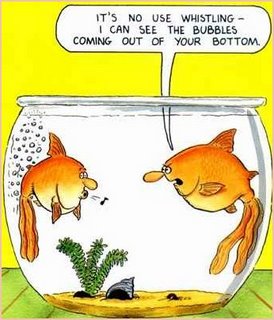
The programme which I wrote about yesterday gave rise to several thoughts about my own care in the future, if a time comes when I can no longer live independently. I made notes and here is the message I want to leave for my sons:TO MY SONS
If I become incapable of looking after myself:
I would not expect any of you to take care of me in your own home. You must be committed to the future, rather than the past; that is nature’s way, however hard.
But if I have to go into care, please don’t abandon me there. If I have not been able to arrange my own care, try to put me somewhere where you can visit me regularly, if not necessarily often.
Remember I am still the person you have known all your life and who has loved you all your life, and you are likely to be the most important thing in my life at this stage.
Don’t lie to me and say I will get better and come home if I won’t. The truth between us can be used positively, while lies are more likely to create suspicion than to reassure.
If I no longer have my wits:
DON’T let anyone leave me parked in front of a TV which is permanently on, and over which I have no control. The end of life needs to be faced with a quiet mind. The playing of good music on occasions may be a good thing however.
If you talk to others in my presence, do so as though I can hear what you say – who knows, maybe I can.
Just be content to be with me at times – you don’t have to talk all the time to be companionable and give comfort, and it will take so much of your energy if I cannot respond.
At the end:
If you possibly can, be there with me and hold my hand, so that I can feel your loving presence as I go.
 This is the title of a strand of TV documentaries showing on Channel 4 this week, which kicked off on Monday with a programme by Tony Robinson called “Me and my Mum”. Channel 4 describes the programme as “an intensely personal look at the plight of Britain's elderly in a film about his 89-year old mum, Phyllis, who suffers from dementia and lives in a care home.” Tony himself says: "I'm angry at the way old people are treated in this country. I feel frustrated that no one ever talks about it.”
I found this a very courageous film, in which Tony looked at the reality of the decisions which have to be made when our parents can no longer live independently, and revealed his own doubts about whether he made the right decision for his mum. He talked about it with his son and daughter, and with others who have faced the same problem, and admitted to feeling guilty because he does not feel able to look after his mum at home. At the same time he pointed out that we should not feel guilty that we have such feelings, as they are common to so many of us.
One of the questions which came up was whether we should lie to our old people about whether they are going to get well again and be able to go home. One family had decided that it was kinder to lie, but their elderly father clearly suspected he was being ‘dumped’ in a care home, and he died within a few days of being moved there.
My own choice would be for the truth, for it may be possible to use the truth in a positive way, while lies, it seems to me, are more likely to create suspicion than to reassure. I remember too that my own mother chose not to let my father know that he was dying, but felt deeply deprived herself by not being able to share her last times with him in a fully open manner.One of the conclusions reached by Tony Robinson was that we give a low priority to human happiness in our care for the elderly. “When people get old and doddery they can’t stand up for themselves any more” he said, “so they stop complaining and we stop listening. Do we try to make full and happy lives for our old people, or only to manage the end of their lives efficiently?” he asked. A good prompt there for all of us, as we try to make the difficult decisions.
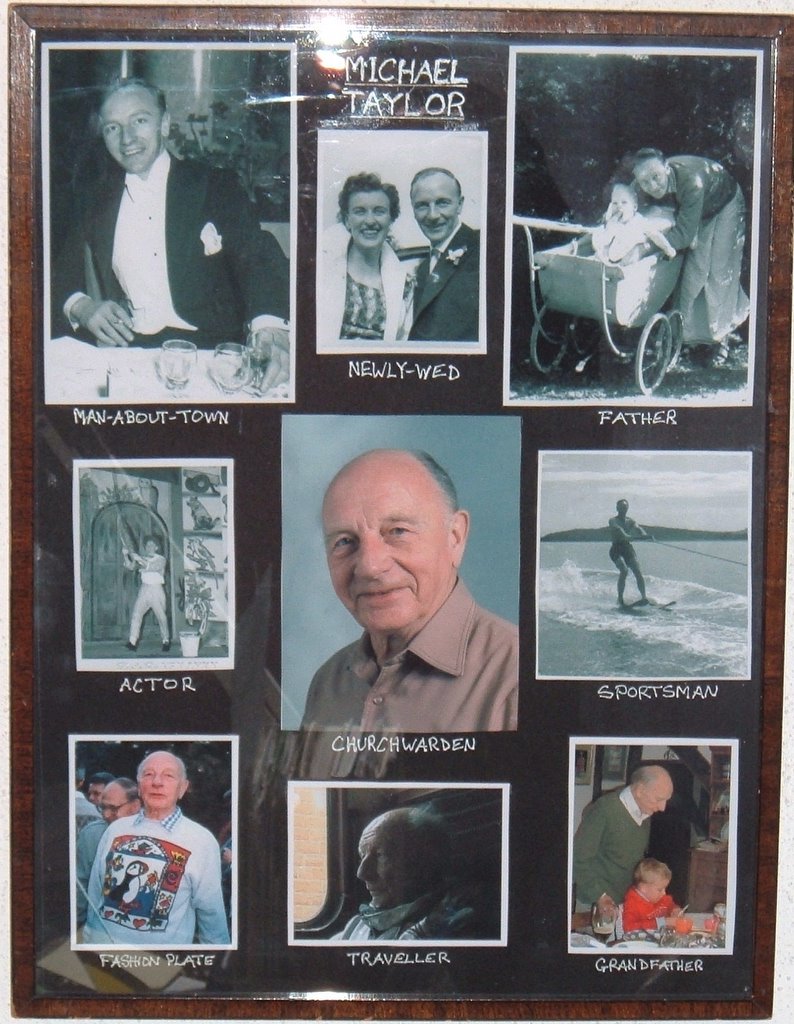
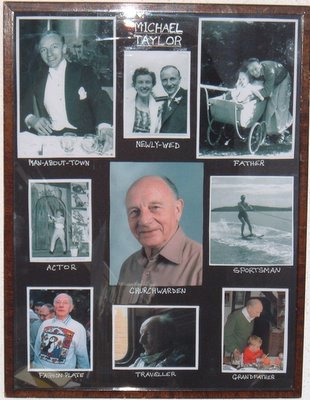 Unfortunately, there are very few surfaces in hospitals on which to place photos etc, and priority goes to water jugs, chocolate, fruit, tissues, coffee cups, reading matter, and so on, so my idea of standing our photograph (see previous blog) on his table didn't work very well. However, Michael has now been moved to a single room in our local cottage hospital, and by a happy circumstance, one of his guests knocked a picture off the wall and broke the ring. So with a spare nail to hang it on, I was able to create a full montage in a frame. (I should have photographed it before I put it behind glass.) I told him I had done it so that people will know who he really is, not just a body in a bed. He seemed quite pleased about it. He had two visitors just after I had put it up for him, and they thought it was a great idea. But I am more interested in what the staff will make of it - will it affect their attitude to him at all? It certainly gave me a lot of pleasure to do it for him, and I can't wait to start on my own.
 Yesterday I was visiting Michael in hospital. He is 88, and I have known him since I was 19. He has severe heart and lung problems, and suffers from blackouts and falls and sundry other afflictions. He is shrunk and bent with age and very frail, but has been struggling to look after himself living alone. He is courageous and uncomplaining, and stubborn with it. It has been difficult to persuade him to accept help from friends and family. But a crisis occurred which could not be dealt with at home.
I am struggling with the reality of this. I am ten years younger than he is, but I have never been as robust physically as he has been for most of his life. How long before it is me in that hospital bed? How will I deal with it? How will I deal, if I have to, with being incontinent in public, and being too weak and short of breath to get myself to a private place and put myself to rights?
And how do I deal with the pain of seeing this old and valued friend in such a state of disintegration? Maybe I can learn something which will help me if and when it is me who is falling apart? I look at him now and try to see him in my mind as he was all those years ago, the young man walking towards me down the platform of his local railway station, on the occasions when I used to visit him by train: the swing of the shoulders, the jaunty step and the insouciant air, in a rather disreputable mac with a long knitted scarf dangling almost down to his knees. That man must still be there inside this insubstantial one in the bed before me.
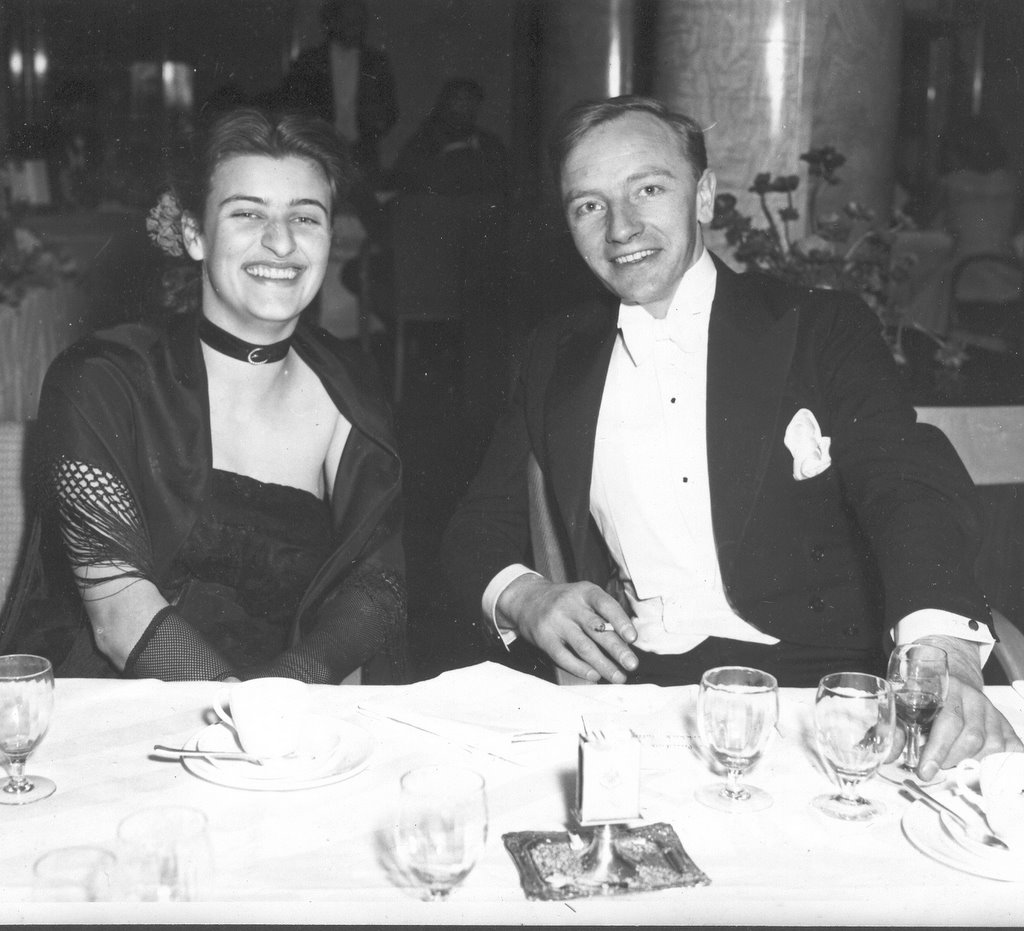
Today when I visit I am taking him this photograph of the two of us at a dinner dance when we were young. I hope he will be able to keep it on his locker, so that everyone can see who it really is in that bed, and treat him accordingly. And I think I will start now to put together a collage of my favourite pictures of myself, so that if and when I arrive at the same state, I can look at them and know that I am something more than a geriatric statistic!
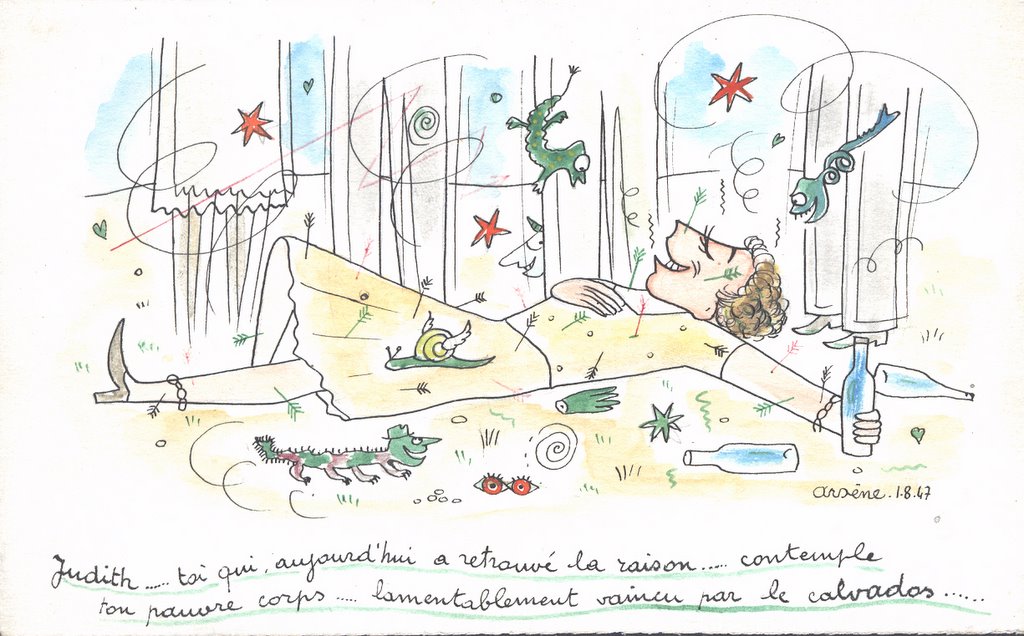
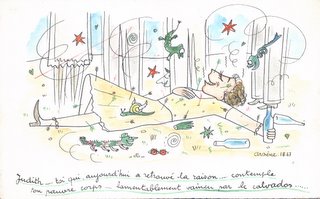 "Judith ... toi qui, aujourd'hui a retrouve la raison ... contemple ton pauvre corps ... lamentablement vaincu par le calvados ... "
I found this cartoon among my papers recently. It was drawn in 1947 by a young French cartoonist called Arsene, when I was staying at the age of 19 with a pen-friend in France. Lucette and I had been invited to tea by friends of hers, and Arsene, her neighbour and friend, was there too. 'Tea' turned out to be a misleading term, as we found ourselves sitting round a table in the garden during a heatwave, eating sweet sticky cakes, but also drinking one type of alcohol after another, mostly liqueurs as I recall. At that time I still had very little experience of alcohol - nice girls didn't start very early in those days - and had no realisation of the impact such a quantity and mix was likely to have on my system. And politeness seemed to require that, as a guest, I try a little of everything offered.I have a vague memory of going somewhat dizzily into the house to the loo, and then nothing ..... until I woke up flat on my back on the lawn, having passed out! Arsene, (for whom I later developed a romantic but innocent attachment), took advantage of the moment to draw this picture of me, which he captioned: "Judith ... you who today have recovered your reason ... contemplate your poor body ... lamentably overcome by calvados....."I barely recall being taken back by car to Lucette's house, but have acute memories of the raging thirst which attacked me during the night. Lucette's family had a very small house, and the only tap was in the kitchen. To get a drink I had to make my way through the house in the dark, unlocking every door on the way, as the family was highly security conscious. I made this arduous trip several times during the night. The morning light illumined a lesson learned, and I have never been incapable again!Seven years later I was living in Geneva and working for the World Health Organisation. We were very well paid and led a pretty rackety lifestyle. My memories of my first hangover must have partly inspired this cartoon which I drew in illustration. The caption, "Si verres sales m'etaient comptes..." translates as: "If dirty glasses were counted against me..."; it is a play on the title of a film of the time: "Si Versailles m'etait conte".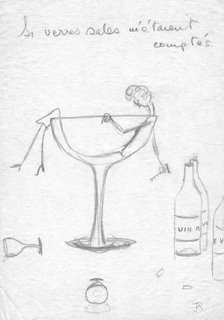
 Just heard that one of my readers is concerned that I have not written in my blog for so long. It feels good to know I have an audience (of one at least!) on the other side of the Atlantic, who is interested enough in my blog to notice and care. Even with the slow increase on the hit counter, it is hard to believe that one is being read, and I would love to have more comments, even if they are critical. I enjoy being unexpected and provocative, but perhaps I am deluding myself in thinking that what I write is anything out of the ordinary these days. I am fairly sure that I do not conform wholly to the general stereotype of an old woman, but there must be many other atypical old crones out there, and I would love to read their blogs too.