Permission to hug,
dear friend, how shall I seek it?
No need - you kissed me!
.
.
[Drawing by Mimi Noland, from The Little Book of Hugs by Kathleen Keating]
 Even elderly sclerotic blood vessels like mine have enough flow space left in them for the sap to rise a little on a day like today. The first real feel of spring was in the air when I went shopping in the local town. As I locked my car and set off for the centre, my spine straightened - (well, that must have been an illusion, but it felt like it) - and a spring came into my step. And lordy! lordy! what's this I'm feeling now? A surge of yearning? No, it's positively a sense of arousal..... and bang goes my hard won acceptance of age and increasing decrepitude.
 Nobody even worth smiling at in my line of vision unfortunately.... which reminds me that I'm still trying to work out how to flirt in an appropriate way at the age of 79. But the mood of renewal sticks around for a while, and after printing out a statement in the bank, showing a debit balance, I go on to spend too much money on things I don't need. Shall I have lunch in town? No, better hurry home before I commit worse follies, either of expenditure or of misplaced sexual reawakening.
Tomorrow it will probably be snowing again, and I shall have to renew the struggle against the temptations of salty crisps, chocolate and Danish pastries. If I work hard at that, I might put my photo up on one of the online dating websites..... or I might not.

I had the unhappy experience recently of having to stand by and watch the paramedics spend half an hour trying to revive a sick old man of 89, whose heart and breathing had stopped, but whose brain was still giving out an electrical signal. I knew that he had agreed with his GP that his hospital notes should carry the notation DNR, or “do not resuscitate”. It was his wish, in which his family supported him, knowing that resuscitation would be likely to leave him worse off than before.
But it seems that here in the UK, unless there is a letter from a doctor written within the previous two weeks, stating that the patient need not be resuscitated, the paramedics are legally obliged to continue trying, until not only the heartbeat and breathing have stopped, but the last electrical signal from the brain as well. If they have had no success after a certain time, they must take him to hospital where doctors can make the decision.
Is there no way to avoid this happening? I can understand the reason for such safeguards, but it seems unnecessarily distressing at an already painful time. If he had been in hospital they would have let him go, but it had been his wish to remain at home. Or if his GP had been sent for instead of the paramedics, he could have been left in peace and dignity. It is something to think about, if you are preparing for the death of someone you know. Here is a good framework to work with on this and related issues; I believe it originated in the British Medical Journal.
Principles of a good death

[Edited 06.01.08 - I wrote this piece to replace the two previous pieces, at a time when I had decided to delete them as too personal. I have now decided to restore them as the truer versions, but I am leaving this in place too. It has some interest as an exercise in writing about one event in two different ways.]
 I started my blog to write about the realities of being old, and with the hope of breaking down some misconceptions and taboos. I know that I am writing rather a lot under this label at present, but but it's been a tough year for me in this respect. And there are certainly other people out there who are prepared to look at what lies ahead, and consider what arrangements, if any, they can make for the end of their life. I hope that the rest of you will forgive me, and move on to another post.
An earlier post reminded me of something I found on the web a while ago - ( I think it originated in the British Medical Journal) - which gives one a framework for thinking about this. And I believe that there is a move in the NHS for hospitals to develop their own protocols and care pathways for the terminally ill along the lines of these principles. I am trying to find out more on the web.
Principles of a good death

 This is a distressing subject. I need to write about it because I am still distressed by what happened. And I think it may be helpful to others in a similar situation. But you don't need to read it, so give it a miss if you'd rather.
 When my husband was in hospital for one of his fairly frequent recent visits, he agreed with his doctor that his notes should carry the letters ‘DNR’, for “do not resuscitate”. We were all relieved that he agreed to the notation, as we knew he was living on borrowed time, and that with his age and present state of health, resuscitation would be likely to leave him in a much worse state than before. Nobody talked to us, however, about what would happen in this connection if he died at home, as he hoped to.
When I got the call from his carer, to say that she thought he had gone, but had called the paramedics anyway, I was over at his house within 15 minutes. I made straight for the stairs so that I could be with him, but the paramedics turned me away, saying "We are doing all we can for him". The significance of those words did not register with me straightaway, and it was some time before I realised that they were trying to resuscitate him.
My pleas to them to stop were useless. The fact that nobody wished him to be resuscitated, including he himself, counted for nothing. Here in the UK, unless there is a letter from a doctor written within the previous two weeks, stating that the patient need not be resuscitated, the paramedics are legally obliged to continue trying, until not only the heartbeat and breathing have stopped, but the last electrical signal from the brain as well. If they have had no success after a certain time, they must take him to hospital where doctors can make the decision. Once I understood this I rang our GP at once; but thankfully, by the time he arrived, after half an hour's strenuous efforts to revive him, my husband had finally 'died' in their terms.
I can understand the reason for such safeguards, but I found it excessively painful at an already painful time. If he had been in hospital they would have let him go, and I could have sat beside him and held his hand. And perhaps while his brain was still bravely sending out its signal, although his heart had stopped, it might also have recognised in some little corner that I was with him. Instead I was barred from his presence, because in the bathroom where he lay there was not room for me as well as the paramedics.
And if it had been me who found him at home, and not his carer, perhaps, knowing his wishes, I could have sent for his GP instead of the paramedics, and we could have been peacefully together at the very last. It is something to think about.
[Edited 06.01.08 - I deleted this post for a while and wrote an alternative version, as I felt it was too personal. Now I have decided to restore it as the truer version. I have left the alternative version too (see 12th February), as the two together have some interest as an exercise in writing about one experience in different ways.]
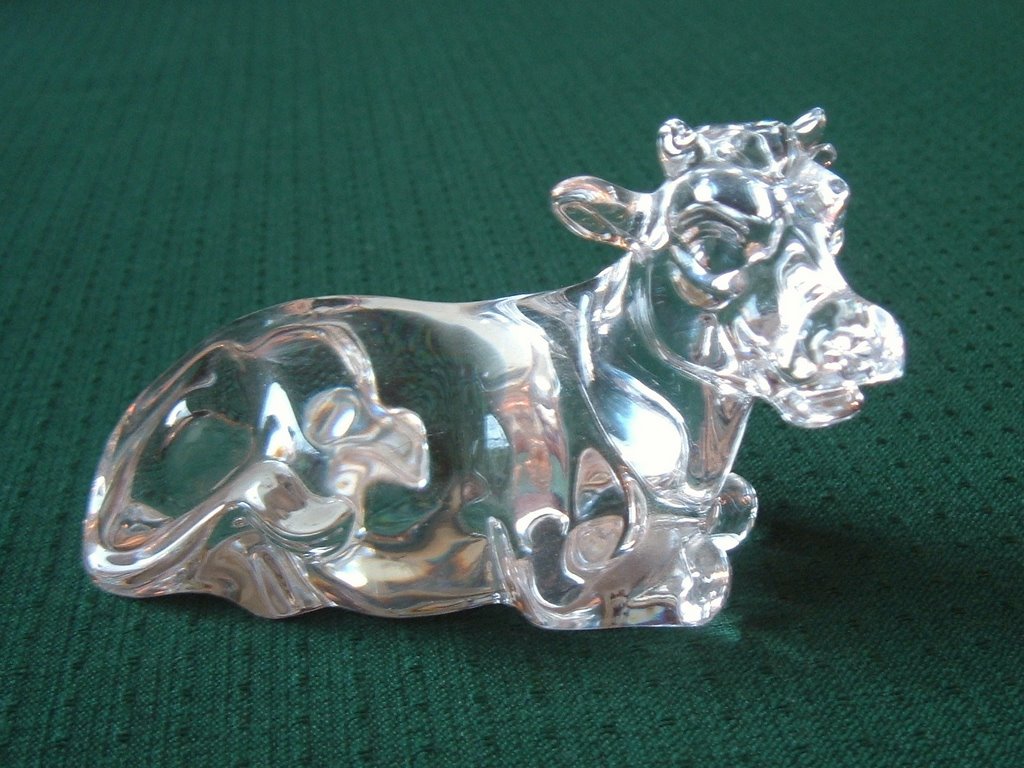 I wrote here the other day about my collection of cows, and how I still needed to find a gold one and a glass one for my collection. Very soon after I was able to write here about finding a gold one on eBay, at the suggestion of my friend Pam.
 I have never been much good at sticking to one thing and seeing it through ... unless, that is, I get into really serious campaigning mode, to try to right a wrong, or bring about some necessary good. I have found myself caught up in such efforts several times since my retirement, and have invested a great deal in them. But when it comes to hobbies and pastimes, I am apt to flit and flirt and dabble and dally, but never to finish.
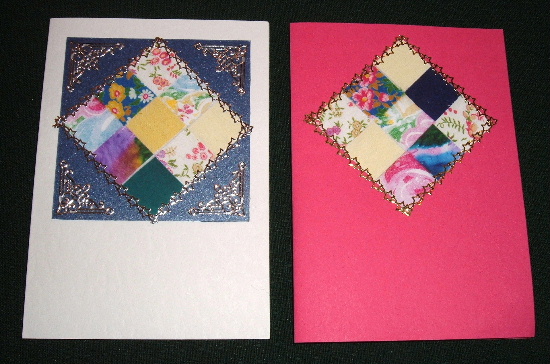 I attended a couple of craft workshops in the past year, and got all excited by what I produced there, rushed out and bought materials, and then left them sitting in boxes waiting for further attention. One was about making patchworks of fabrics which could be scanned to make greetings cards.
 Another was about Kumihimo, the Japanese art of braiding. I came home and did a few more with leftover embroidery wools, bought a couple of starter kits ... and stopped.
 Also I have a drawer full of favourite fabrics, many of them from clothes which I couldn't bear to throw away, which I want to make up into covers for scatter cushions to have around the house. I made two for my first granddaughter, two for myself and then, once again, I stopped.
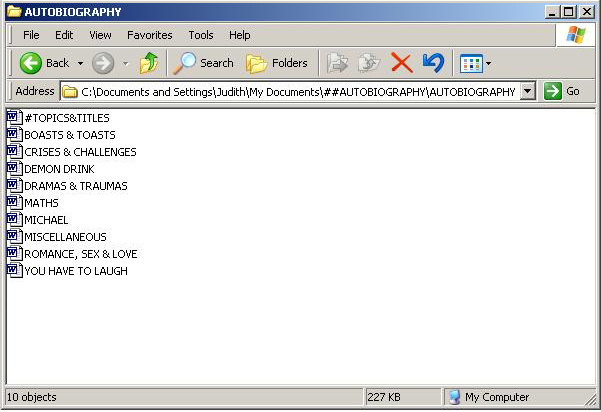
 Then there are all the computer projects: my autobiography, which has hardly got into gear yet, though writing for my blog is helping. But I have a huge list of topics I want to write about but haven't got around to yet. And the photographs: CDs for my sons with pictures of their mum and dad, and CDs of each of the boys with their own families; and an archive of ALL the old family pictures I have inherited, which means hours of scanning.